Table Of Content
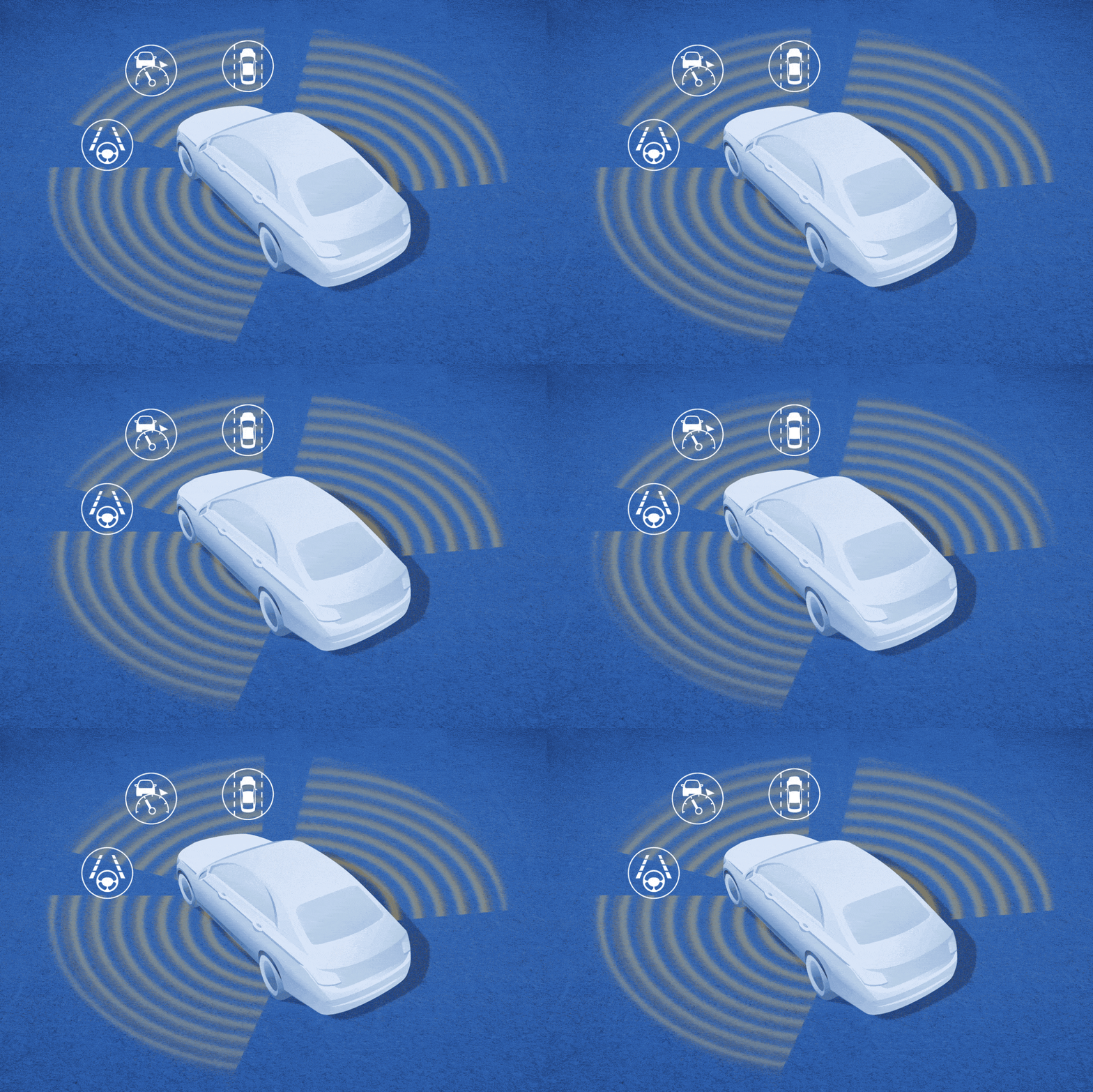
If there are multiple vehicles in the sensor’s field of coverage at the same time, it automatically selects which of the vehicles the system should track. The purpose of a cruise control system is to accurately maintain a speed set by the driver without any outside intervention by controlling the throttle-accelerator pedal linkage. At any time during your drive, if you want to drive manually, you can "stop" cruise control by pressing the clutch and/or accelerator. Regardless of where the cruise control system is located in your car, they're governed by the same mechanisms. There will be an ON and OFF button(s), a SET button, a RESUME button, and a CANCEL button. Sometimes, you may get extra buttons to speed up or slow down while in cruise control mode.
Do Car Safety Features Reduce Car Accidents? – Forbes Advisor - Forbes
Do Car Safety Features Reduce Car Accidents? – Forbes Advisor.
Posted: Tue, 02 Apr 2024 07:00:00 GMT [source]
Types of Cruise Control Systems
Moreover, if you try installing an aftermarket kit, you may void the warranty offered by the OEM (Original Equipment Manufacturer). On top of that, it is not recommended to go for an aftermarket cruise control kit as it may compromise safety. Adaptive cruise control is the next big thing in terms of automated speed management in new cars. It is an intelligent form of cruise control that slows down and speeds up automatically to keep pace with the car in front of you.
How is adaptive cruise control different?
Picture it like a synchronized dance on the highway, where every car knows its place and keeps the right distance. For example, Audi's Traffic Jam Assist technology can be activated in tandem with its adaptive cruise control, thereby supporting the driver in conditions that aren't optimal for the latter. By means of ultrasonic sensors, radar, and a windshield camera, the vehicle will maintain a consistent distance from the one ahead in traffic while staying oriented on the road. The driver takes full manual controlwhen the congestion clears or Traffic Jam Assist otherwise becomes unsuitable for the situation. Two companies are developing a more advanced cruise control that can automatically adjust a car's speed to maintain a safe following distance. This new technology, called adaptive cruise control, uses forward-looking radar, installed behind the grill of a vehicle, to detect the speed and distance of the vehicle ahead of it.
Check your car’s controls
When used appropriately, conventional and adaptive cruise control are safe. The buttons to activate cruise control or accelerate/decelerate may vary from one car to another. So, do check the owner’s manual before fiddling around with the system. It’s better if you are familiar with the controls before driving the vehicle, as it will avoid unnecessary distractions. Cruise control in a car replicates the inputs of a driver to control the vehicle’s speed.

Cooperative Adaptive Cruise Control (CACC)
By maintaining a constant speed, cruise control helps reduce fuel consumption, leading to better gas mileage. Rapid acceleration and deceleration, on the other hand, can lead to increased fuel consumption. Predictive Cruise Control is like the fortune teller of cruise control systems. It uses GPS and map data to see into the future and predict what's coming up on the road, like hills or curves, and adjusts your speed accordingly.
Adaptive cruise control
” mapfreinsurance.com/blog/how-does-cruise-control-in-cars-work (accessed July 11, 2023). The below table highlights the key differences between cruise control and adaptive cruise control. Step 4 - Keep your eyes on the road as it is very easy to get distracted when the car is accelerating automatically. A governor was used by James Watt and Matthew Boulton in 1788 to control steam engines, but the use of governors dates at least back to the 17th century.
Cost Effective Cars
From grinding and rattling to thumping and squealing, you can learn how to decode... Kelley Blue Book® Values and pricing are based in part on transactions in your area. Your ZIP code also helps us find local deals and highlight other available offers.
Who are the leading innovators in adaptive cruise control for the automotive industry? - just-auto.com
Who are the leading innovators in adaptive cruise control for the automotive industry?.
Posted: Wed, 25 Oct 2023 07:00:00 GMT [source]
Fuel Efficiency
The result is that the closer the car gets to the desired speed, the slower it accelerates. Also, if you were on a steep enough hill, the car might not accelerate at all. Before engaging the cruise control in a car, remember that the system is not intended to be used in adverse weather conditions. For example, you may refrain from driving the car at cruising speeds when it’s raining heavily.
What is the difference between cruise control and speed limiter?
However, as a driver driving on cruise control, you must remain attentive with your eyes on the road for a safe drive. Additionally, ensure you have a relevant car insurance policy to protect against third-party liabilities and accidental damages to your car in case of unfortunate events like road accidents and collisions. You can browse our insurance plans and select one according to your specific needs and requirements.
It's perfect for those long drives on open highways, but it doesn’t automatically react to other cars on the road. Some drivers often have the luxury of wide, peaceful, near-empty roads. For others, driving tends to be a commuter's cacophony of traffic jams, honking horns, and slow stop-start-stop-start progress. The experience can differ greatly depending on the time of day and whether it's a weekday or the weekend. The bottom line, though, is that one of these scenarios is a far better fit for cruise control than the other. Additionally, adaptive cruise control provides a button to establish the minimum distance it will accept before responding to the slowing or stopped car in front of it.
Modern "adaptive" systems include the ability to automatically reduce speed when the distance to a car in front, or the speed limit, decreases. The cruise control takes its speed signal from a rotating driveshaft, speedometer cable, wheel speed sensor from the engine's RPM, or internal speed pulses produced electronically by the vehicle. Most systems do not allow the use of the cruise control below a certain speed - typically around 25 or 30 mph (40 or 48 km/h). Once familiar with your car’s cruise control system, you can try it out.
The cruise control system actually has a lot of functions other than controlling the speed of your car. For instance, the cruise control pictured below can accelerate or decelerate the car by 1 mph with the tap of a button. There are also several important safety features -- the cruise control will disengage as soon as you hit the brake pedal, and it won't engage at speeds less than 25 mph (40 kph). Car cruise control works when a driver sets a certain speed for the car to "cruise" at. The vehicle maintains this speed by controlling the throttle to the accelerator link.
However, the location of the button may vary depending on the make and model. However, almost all vehicles costing above Rs. 5 lakhs are equipped with cruise control. Cruise control makes driving easy and convenient, and at the same time, it also takes care of safety. But like every other feature, it has its own set of advantages and disadvantages, which are elaborated in the following section. It is a complex process to install the system in new cars as you have to fiddle with electronics, and it also requires the fitment of hardware.
This sensor then controls the speed of your car so that it always stays 2-3 seconds behind the car in front. Cruise control is safe when operated in safe driving conditions, by drivers with valid licenses who are sober and able to drive and use cruise control. Always make sure to keep your eyes on the road, your vehicle cannot make driving decisions - you'll need to step in if need be. General Motors’ Super Cruise system is available in select Cadillac models and provides hands-free driving assistance on compatible highways. It uses LiDAR map data, high-precision GPS, and a driver attention system to ensure safety. Unlike Tesla’s FSD, it’s limited to highway use but excels in hands-free driving comfort and safety.
If the car begins to slow down because of an incline (e.g. going up a hill), the system will open the throttle to accelerate. Conversely, if the car starts to speed up due to a declin (e.g. going downhill), the system will close the throttle to decelerate. Cruise control is a handy feature for drivers that allows you to maintain a constant speed without having to keep your foot on the gas pedal.
Cruise control is a feature allowing the driver to set a predetermined speed, which the system’s computer maintains until the driver adjusts the speed, taps the brake, or disengages the system. In other words, once set, the cruise control system automatically controls vehicle speed, relieving the driver of that responsibility. In a proportional control system, the cruise control adjusts the throttle proportional to the error, the error being the difference between the desired speed and the actual speed. So, if the cruise control is set at 60 mph and the car is going 50 mph, the throttle position will be open quite far. When the car is going 55 mph, the throttle position opening will be only half of what it was before.

No comments:
Post a Comment